

This briefing examines the characteristics of people migrating to the UK and explores their reasons for migration: work, study, family and protection.
-
Key Points
- More than eight in ten people who moved to the UK between 2021 and 2024 were non-EU citizens
More… - Indian was the most common nationality of people migrating to the UK since 2005, and Indians accounted for a quarter of all non-EU arrivals since 2021
More… - In the four years since Brexit, over 90% of EU nationals came to the UK for work or study
More… - Study and work have consistently been the main reasons that people migrate to the UK
More… - Family migration made up 10% of immigration in 2024, but this group is one of the most likely to settle permanently in the UK than people who come for work or study
More… - The fastest-growing route between 2021 and 2023 was health and care, although the numbers reduced in 2024
More… - More dependants came with main applicants between 2021 and 2024 than previously, although this trend has tailed off following policy changes
More… - Migration for humanitarian reasons was much higher between 2021 and 2024 than in previous periods, partly due to bespoke schemes for Ukrainians and Afghans
More…
- More than eight in ten people who moved to the UK between 2021 and 2024 were non-EU citizens
-
Understanding the Policy
Migrants’ reasons for moving to the UK are usually classified into four main categories: work, study, family, and protection. ...Click to read more.Since EU freedom of movement to the UK stopped at the end of 2020, all non-UK citizens (except for Irish citizens) who wish to move to the UK face broadly the same immigration controls. These rules are more restrictive now for EU citizens than they were under free movement. For non-EU citizens, however, certain immigration routes became less restrictive than they were before Brexit.
Work
Non-UK citizens coming to the UK for work must apply for a work visa. Most work visas allow for residence of several years, although a small proportion, including seasonal worker visas, are for stays of less than one year. Some work routes put the visa holder on a path to permanent settlement (known as indefinite leave to remain or ILR). These include the skilled worker route and routes based on investment, business development and talent. Long-term work visa holders can usually bring their partner and children to the UK – these people are referred to as dependants. Work visas that allow people to take up low-wage positions are usually strictly temporary and do not allow for visa holders’ dependants to join them (e.g., the Youth Mobility Scheme or the Seasonal Worker route). A previous exception to this was care work – a low-wage job requiring few formal qualifications. In 2022, care work was added to the list of eligible occupations for the skilled worker route, giving care workers the right to bring dependants and a path to settlement. However, from March 2024 onwards, new care workers coming through this route were prevented from bringing dependants, and the route was closed to all new overseas applicants in July 2025. It was due to be closed to all applicants (including people switching in-country) in 2028.
The change to the dependant rules is described in more detail in the Migration Observatory’s The ban on care workers’ family members: what will be the impact? Information on work routes more broadly can be found in Migrants in the UK labour market: an overview and Work visas and migrant workers in the UK.
Study
Non-UK citizens who want to study in the UK must be sponsored by a licensed educational institution, meet English proficiency requirements and show they have sufficient funds to maintain themselves during their studies. They usually pay unsubsidised tuition fees. Until January 2024, graduate students could bring their partner and children to the UK; since then, only PhD students and master’s students on research courses can bring family (Home Office and Department for Education, 2023). A student visa allows for temporary residence for the duration of the person’s course. Students who want to remain in the UK after that must apply for another visa.
It has been suggested in the past that students should not be counted in the official long-term migration figures on this basis. However, the proportion of students switching to another visa once in the UK rose after Brexit, suggesting that a larger proportion were staying long-term. This change followed the opening of the Graduate Route in 2021, which allowed students to remain in the UK for two years after completing their course (three years in the case of PhD students) with the right to work but no requirement to do so. In May 2025, the government announced it would be reducing the Graduate Route residence period to 18 months (except for PhD students). Time spent in the UK on a student visa does not count towards the required residence period needed to apply for ILR (settlement), nor does time spent on the Graduate Route.
More information on international students is available in the Migration Observatory briefing, Student Migration to the UK.
Family
Analysis often distinguishes between ‘family migrants’, who come to join a UK citizen or person with permanent settlement rights in the UK (known as ‘family unification’), and ‘dependants’, who accompany or join a person on a temporary visa, such as work or study. Under family unification, UK citizens and permanent residents can sponsor family members to join them in the UK. The only family members eligible for family unification visas are spouses or civil partners; fiancé(e)s or proposed civil partners; unmarried partners (including same-sex partners); children; and, in a smaller number of cases, adult or elderly dependent relatives. Family members are also usually required to demonstrate a level of English language proficiency in order to enter the UK or extend their stay. Since July 2012, the British citizen or permanent resident who acts as a sponsor needs to meet an income requirement, which was initially set at £18,600 if sponsoring a partner and more if they bring one or more children. In early 2024, the income requirement was raised to £29,000. The incoming government in 2024 commissioned a review, published in June 2025, and at the time of writing had not yet announced its plans for the threshold. In addition to the main family unification route, there is a specific Refugee Family Reunion route for people who have been granted asylum or protection.
For a more detailed discussion of family migration, see the Migration Observatory briefing, Family Migration to the UK.
Protection
There are different types of migration for protection. Non-UK citizens can seek asylum in the UK under the United Nations 1951 Refugee Convention. Refugee status is to be granted if the asylum-seeker has “a well-founded fear of being persecuted for reasons of race, religion, nationality, membership of a particular social group or political opinion, is outside the country of his nationality and unable or, owing to such fear, is unwilling to avail himself of the protection of that country”. Asylum seekers need to reach UK soil to put in a claim. Non-EU citizens who seek asylum in the UK usually arrive (a) without permission; (b) on a visa that has been issued for another purpose, such as tourism or study, or (c) on a transit visa or tourist visa waiver.
In addition, various ‘safe and legal’ routes – as they have been characterised by recent governments – have existed at different times, which have granted permission for people to enter and live in the UK on humanitarian grounds. One category of these is resettlement, in which refugees are selected from locations outside of the UK and brought here by the UK government and the United Nations. In recent years, the UK has also operated a series of bespoke humanitarian schemes, including the Hong Kong British National (Overseas) visa, the Ukraine schemes, and the (now closed) Afghan resettlement and relocation schemes. These routes do not grant refugee status and have different conditions attached – the BN(O) scheme, for example, requires a visa (which has an application fee, which must be paid alongside immigration health surcharge fees) and does not permit the visa holder to access the benefits system.
For more information, please see the Migration Observatory briefing, Migration to the UK: Asylum and Resettled Refugees.
-
Understanding the Evidence
The reasons people have for moving to another country are difficult to unpick, let alone capture in data. ...Click to read more.Migrants’ decision-making is sometimes explained as a response to so-called ‘push factors’ in countries of origin, such as widespread unemployment, economic instability or civil unrest, and ‘pull factors’ in destination countries, such as an accessible labour market or familiarity with the language. English language use, the presence of ethnic and familial ties, and a high earning potential relative to countries of origin have made the UK an attractive destination for some migrants. Specific policies also make the UK more attractive, like the Graduate Route, which allows most international students to remain in the UK for at least eighteen months after graduation. Although people often move countries for multiple reasons, that is not well-reflected in the data, which distil the complexity to exclusive categories, such as work or study.
Most of the data used in this briefing relates to non-UK citizens. British nationals moving to the UK are excluded from the figures in this briefing where possible. For a discussion of migration terminology and its effects, see the Migration Observatory briefing, Who Counts as a Migrant: Definitions and their Consequences.
This briefing uses the Long-Term International Migration (LTIM) estimates produced by the UK’s Office for National Statistics (ONS), which aim to capture anyone moving to or from the UK for at least twelve months and their reason for doing so. The current LTIM series goes back as far as the year ending June 2012 and includes broad categories of reason for migration for non-EU+ citizens only (EU+ meaning EU countries plus Iceland, Liechtenstein, Norway and Switzerland). This category is referred to as non-EU throughout this briefing, for consistency. Reason is inferred based on visa type – for example, work, study or family.
Figures for earlier years included a breakdown of the reasons for non-EU and EU nationals. These figures, which are not comparable with the current series, were based solely on the International Passenger Survey (IPS), which asked respondents for their reason for migration. This survey came with large margins of error and did not capture some migrant groups as well as others. For more information about the current ONS estimates, see the ONS website.
This briefing also uses Home Office data on visas issued to non-UK nationals for work, study, family and grants of asylum and other forms of protection and issuances of visas to other vulnerable groups, such as Ukrainians. It is important to note that not everybody who is issued a visa will necessarily come to the UK – some may change their plans after a visa is issued. The type of visa also may not align with the motivations of the individual or completely describe their main activity while in the UK – for example, a migrant may come on a study visa but view their right to work (up to a maximum number of hours during term time) as an equally important part of their reason for migrating.
Counting the number of people who come to the UK to seek protection involves its own challenges. While the Home Office provides figures on the number of asylum claims lodged in a given year, some of these claims come from people who were already living in the UK. The year of an asylum application does not necessarily reflect the applicant’s year of arrival, and some people make more than one application over time. The ONS’s LTIM estimates account for a proportion of asylum applicants having already been in the UK on a different apparent purpose. For more on the limitations of the asylum data, see Asylum and refugee resettlement in the UK.
This briefing also uses data from the Higher Education Statistics Agency (HESA) on international students. These data classify students by domicile (rather than country of birth or nationality). Domicile is defined as the place of ‘normal residence’ before taking up study, which means that some UK citizens who have been living abroad before coming back to the UK to study will be counted as international students in the HESA data. Nonetheless, HESA provides the most detailed and reliable information about international students in higher education in the UK. See the HESA website for analysis and definitions.
More than eight in ten people who moved to the UK between 2021 and 2024 were non-EU citizens
When looking at which parts of the world migrants to the UK come from, the usual approach is to focus on EU and non-EU nationals as broad groups. In the past, while the UK was still a member of the EU, there were two different sets of immigration rules for these groups, and, up until EU free movement stopped at the end of 2020, EU nationals generally made up the larger share of migrants to the UK.
Between 2021 and 2024, the number of people migrating to the UK from non-EU countries increased and, along with a decreasing number of people migrating from EU countries, this has meant they make up a much higher share of immigration than in the past (Figure 1). In the four years from 2021 to 2024, non-EU migrants accounted for eight out of every ten people who migrated to the UK.
Figure 1

The rising number of non-EU migrants is due to a combination of factors, including more liberal policies towards non-EU citizens compared to the pre-Brexit regime and increased recruitment of international students. A substantial share of non-EU migration during this time – and particularly in 2022 – was through special humanitarian routes which had not existed previously, including the Ukraine schemes and the Hong Kong British National (Overseas) (BN(O)) route. These factors are explored in more depth in later sections of this briefing. Broader socio-economic trends, such as the health of the economy and living standards relative to other countries, are also thought to affect the composition of immigration to the UK, but are difficult to disentangle (Gupta et al., 2023; Jafari and Britz, 2018).
Indian was the most common nationality of people migrating to the UK since 2005, and Indians accounted for a quarter of all non-EU arrivals since 2021
Beyond the broad groupings, we can also look at which specific countries of origin migrants come from. One source of this data is the census, which showed that in 2021, the most common foreign countries of birth of people who were living in England and Wales were India (920,000 people), Poland (740,000), Pakistan (620,000) and Romania (540,000) (ONS, 2025b).
Between 2021 and the end of 2024, Indian was also the most common single nationality of people migrating to the UK. Around 850,000 Indian nationals arrived during this time, making up a quarter of non-EU arrivals (24%) and just under a fifth of arrivals of all nationalities (19%).
This continued a trend of India being the largest single country of nationality for migrants to the UK over a much longer period. Looking at visa statistics, more Indian nationals were granted permission to move to the UK over the period 2005 to 2024 than any other nationality (Figure 2). While work was generally the main reason for Indians to migrate to the UK in the past, migration for study increased substantially since 2021.
Figure 2

Along with Indian, the five nationalities granted the most residence visas between 2005 and 2024 were Chinese, Pakistani, Nigerian, and American. Nigerian and Pakistani have only climbed to the top five nationalities since 2021, in both cases as a result of increased grants of study and work visas.
For more detail, see the Migration Observatory’s Why has non-EU migration to the UK risen? and Why are the latest net migration figures not a reliable guide to future trends?
In the four years since Brexit, over 90% of EU nationals came to the UK for work or study
Before the UK stopped participating in EU free movement at the end of 2020, EU nationals usually made up a large share – often the majority – of people migrating to the UK each year. The peak of EU migration was in the year ending June 2016, which included the date of the EU referendum, when around 520,000 EU nationals came to the UK and 200,000 left, resulting in the net migration of 320,000 people.
Since then, the number of EU nationals migrating to the UK has declined each year while the number leaving has increased. Between 2021 and 2024, net migration of EU nationals was negative, meaning more left than arrived.
During that time, just over 50,000 visas were issued to EU nationals per year or roughly 4% of all residence visas issued. The most common nationalities of EU citizens issued visas between 2021 and 2024 were French (38,000 or 19% of the total), German (33,000 or 17%) and Spanish (26,000 or 13%). Some EU nationals migrating to the UK do not require a visa because they already have the right to live in the UK through (for example, through the EU Settlement Scheme).
In 2024, 92% of visas issued to EU nationals were for work or study (51% for work, 41% for study), and the rest were largely for family-related reasons. Within the category of work, roughly half of visas issued to EU nationals were for skilled work. Data on EU citizens’ reasons for migration prior to 2021 are unavailable, and so their reasons for migrating have to be estimated. Up until March 2020, these estimates suggest that work was consistently the main reason EU citizens migrated to the UK, with most having had a job lined up before arriving.
Study and work have consistently been the main reasons that people migrate to the UK
The main reasons people move to the UK are for work or for study, with work having been the more common reason in most years since at least the start of the 1990s. There were two periods in which study, which refers to people coming to the UK for higher education, was the most common reason: the first between 2009 and 2012, after which the government introduced policies to restrict study visas, and more recently between 2019 and 2022, and again in 2024. The recent rise reflects a policy in the university sector to recruit more international students, in the context of a tighter funding environment.
The ONS’s 2024 migration estimates only included the reason for migration for non-EU nationals, although this group made up the large majority of migrants to the UK. In 2024, study and work were the main reasons for non-EU migration, with 266,000 and 262,000 people migrating for these respective reasons (including dependants) (Figure 3).
The third main reason for non-EU immigration has typically been ‘family’, which can include a partner and children coming to join a migrant who is already in the UK. This was replaced between 2021 and 2023 by ‘humanitarian’ reasons, which include asylum seekers, Ukrainians arriving under bespoke routes, resettled refugees, and Hong Kong BN(O) status holders.
Figure 3

Family migration made up 10% of immigration in 2024, but this group is one of the most likely to settle permanently in the UK
Specific routes exist for non-UK citizens to join a family member already living in the UK – this family category is counted as distinct from dependants who come with a main applicant on a temporary visa (e.g., work or study) at the same time they arrive or shortly after (see Understanding the policy).
In 2024, around 72,000 non-EU nationals – 10% of the total – migrated for family reasons. Equivalent figures are not available for EU nationals, although visa figures show that around 7% of residence visas issued to EU nationals in 2024 were for family routes. The 10% figure was typical of previous years, although the proportion had been briefly higher, at around double this in 2019 and 2020.
The number of people migrating via the Refugee Family Reunion route increased sharply from around 4,000 in 2022 to nearly 20,000 in 2024 (Figure 4). The numbers coming on this route largely mirror trends in grants of protection in the preceding years.
Family members are more likely to settle permanently in the UK than people who come for work or study. Among people granted an initial visa to come to the UK in 2019, for example, 89% of family visa holders still had valid leave to remain five years later at the end of 2024, compared with 45% of work visa recipients and 25% of those who had been granted study visas. Only migrants who arrived on protection routes showed a higher likelihood of settling (95%). The higher propensity to settle among family migrants is one reason why, despite making up small shares of arrivals in any given year, 35% of the foreign-born population living in the UK in 2022 said that they came for family reasons (Jorgensen and Walsh, 2023).
Figure 4

While the share fluctuated somewhat between 2021 and 2024, the numbers have remained relatively stable while other immigration routes have seen large increases following changes to the UK immigration system. Family route numbers have been affected in the past by policy changes, such as decisions in 2010 and 2012 to impose language and income requirements on non-EU citizens applying to join or accompany family, which brought the number of family visas issued to a low point of around 29,000 in 2013 (Home Office, 2011; Sumption and Vargas-Silva, 2019).
For a more detailed analysis of family immigration, see the Migration Observatory briefing Family migration to the UK.
The fastest-growing route between 2021 and 2023 was health and care, although the numbers reduced in 2024
In 2020, the government introduced a health and care visa route – a subcategory of the skilled worker route – to attract professionals in this industry to the UK. Following a sustained period of high vacancies in the care sector, in February 2022, the route opened to care workers in low-qualification, low-paid roles who, like others on the skilled worker route, were initially allowed to bring dependants.
In 2021, the health and care visa was mainly used to recruit nurses, but this changed in 2022 with substantial recruitment of care workers (Figure 5). In 2023, 348,000 people were granted visas under the health and care route, making it the largest work category and the second largest visa route overall, after international study.
Nationality data for the health and care route shows that Indians, Nigerians, and Zimbabweans accounted for nearly two-thirds (63%) of people admitted on the route between 2021 and 2024. Other countries of nationality supplying the highest numbers to the route were Ghana, Pakistan, and the Philippines.
Figure 5
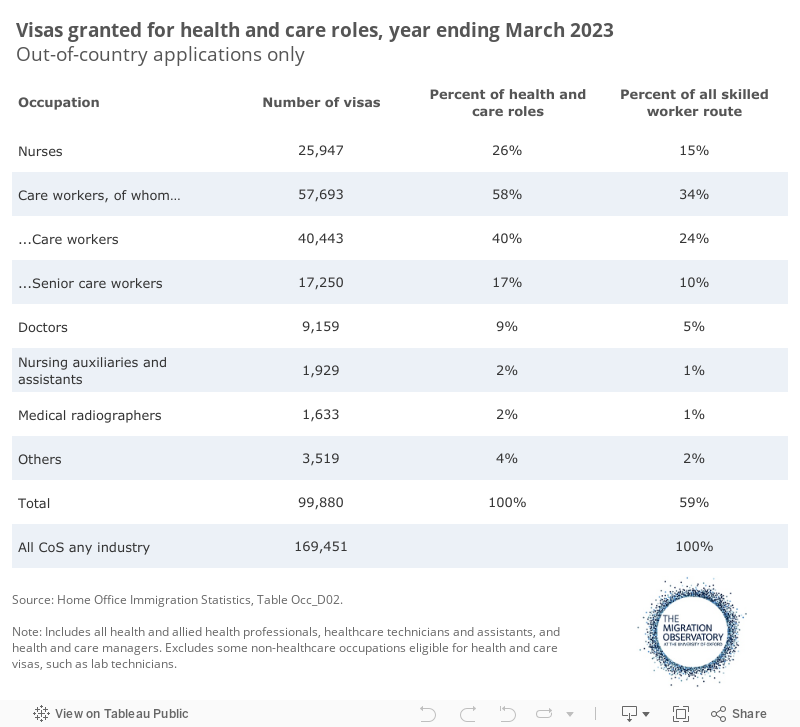
During this time, there was a high ratio of dependants to main applicants on the health and care route. In 2023, dependants outnumbered main applicants at a ratio of around 4 to 3. The top nationalities coming under the route also had some of the most dependants relative to main applicants. Two-thirds of the Nigerians coming on the route have been dependants rather than main applicants.
More dependants came with main applicants between 2021 and 2024 than previously, although this trend has tailed off following policy changes
In 2023, over half (53%) of visas issued for work and study were for dependants rather than main applicants (see the ‘Understanding the policy’ section for an explanation of dependants as opposed to family migrants). This amounted to around 421,000 people who were granted entry as dependants in that year, 191,000 of whom (45%) were children (Home Office, 2025b). These numbers and proportions were highly unusual – between 2005 and 2020, the number of dependants coming on these routes was, on average, 64,000 per year and 19% of the total.
As noted in the previous section, the health and care route was a main contributor to the rise in dependants between 2021 and 2023. Following concern about these high levels, care workers on this route were banned from bringing dependants from March 2024 onwards. Current visa holders could still apply to have dependants join them, so while the number of main applicants on the health and care route fell by four-fifths between 2023 and 2024, the number of dependants fell by just over half. In July 2025, the care worker visa route closed entirely to new applicants.
The number of dependants coming with students also increased between 2021 and 2023 before a similar policy change brought this down again (Figure 6). The number of dependants was highest in 2023, at around 140,000 to 460,000 main applicants or around 24% of the total number of people being granted entry for study reasons.
The rise in student dependants to some extent reflected a change in the nationality composition of foreign students. In 2023, of the nationalities contributing significant numbers of international students, Nigerians brought the most dependants, with a ratio of 1.25 dependants for every one student. Other nationalities with a high ratio of dependants were Sri Lankan, Ghanaian, and Bangladeshi. These nationalities all saw a much larger fall in main applicants after the ban on dependants came in than the fall in international students overall.
Figure 6

The Migration Observatory briefing, Student Migration to the UK, provides a more detailed analysis.
Migration for humanitarian reasons was much higher between 2021 and 2024 than in previous periods, partly due to bespoke schemes for Ukrainians and Afghans
In the four years from 2021 to 2024, twice as many people were granted residence in the UK via humanitarian routes than in the previous twenty years combined (ONS, 2025; Home Office, 2025a). This was due to a combination of factors, notably the launch of the Ukraine schemes in 2022, Afghan resettlement schemes in 2021, the Hong Kong BN(O) route in 2021, and a rise in asylum applications and grants during the same period.
The recent addition of these new routes also means that migration for protection made up a larger share of overall migration in 2022 than in previous years. In that year, when humanitarian migration was at its highest, 278,000 people are estimated to have arrived in this category, equivalent to 23% of non-British migration. While figures are not available for many earlier years, they do show a significant rise since 2019, when humanitarian reasons accounted for 7% of overall non-British immigration.
Before 2021, humanitarian migration to the UK mainly captured people travelling to the UK to claim asylum and a smaller overall number of people being resettled to the UK from other countries, notably Syria (for more detail on this, see Understanding the Policy).
It is difficult to estimate how much asylum seekers add to the overall numbers arriving each year, since the year people are recorded as applying for asylum is not always the year in which they arrived. In 2024, 108,000 people applied for asylum, of whom around 40,000 were found to have arrived on a visa for study, work, visiting or another purpose.
Figure 7

For more detailed analysis and discussion of asylum and refugee resettlement, see the Migration Observatory Briefing, Migration to the UK: Asylum and Resettled Refugees and the House of Commons Library briefing on Asylum statistics (Sturge, 2025). Local-level data on asylum seekers and resettled refugees in the UK are available in the Migration Observatory Local Data Guide.
Data gaps and limitations
The evidence used in this briefing comes from a range of sources which give us different types of information about migration processes. ONS data on long-term immigration, for instance, is the best estimate available of the number of people arriving in the UK for different reasons, but is not very detailed and is subject to some uncertainty. The Home Office visa statistics, by contrast, contain a lot of detail but can only tell us how many visas of a given type were granted, and not, in most cases, how many people actually arrived.
These two datasets are often misaligned because some people issued with visas do not enter the UK, or they arrive in a different year, and while the ONS data adjusts for this, the Home Office’s data only shows visas issued and not confirmed arrivals. An extreme example is that the Home Office data show that 270,000 Ukraine scheme visas were issued between 2021 and 2024, while the ONS figures indicate that only 185,000 Ukrainians are believed to have arrived for at least a year.
Another limitation is that there is a break in the ONS’s series of overall migration estimates, which means the current figures on the reason for migration are only available going back to 2019. Before that, estimates were based solely on data from a passenger survey, and although this meant more detail could be provided on the characteristics of migrants, the estimates were highly uncertain for smaller groups.
The Office for National Statistics is currently changing the way it produces migration statistics by making more effective use of administrative sources (ONS, 2020). While this is ongoing, the figures have been classified as ‘official statistics in development’ and have been regularly revised, sometimes by relatively large amounts. The current estimates are also likely to be revised in future as the method is refined. A consequence of the switch to a new method is that, at the time of writing, the reason for migration can only be produced for non-EU nationals.
This briefing focuses on people who come to the UK with authorisation, except in the case of asylum seekers, who are counted regardless of how they arrive. There are statistics available on migrants detected arriving via unauthorised routes, but it is not possible to tell how many of these individuals are accounted for in, for example, the asylum figures. There is also an unknown level of unauthorised migration each year, which is not detected and hence not counted.
References
Gupta, R., M. Mahadi Hasan, S. Zahurul Islam, T. Yasmin and J. Uddin. 2023. Evaluating the Brexit and COVID-19’s influence on the UK economy: A data analysis. Plos one 18(6), e0287342. Available online.
HESA. 2024. Where do HE students come from?
Home Office. 2011. Overseas Students in the Immigration System: Types of Institution and Levels of Study. UK Border Agency, Home Office, London.
Home Office. 2025a. Immigration system statistics quarterly: March 2025.
Home Office. 2025b. FOI data on outcome of visa applications, by age.
Home Office and Department for Education (2023) Changes to student visa route will reduce net migration. 23 May 2023. Available online.
Jafari, Y. and W. Britz. 2020. Brexit: an economy-wide impact assessment on trade, immigration, and foreign direct investment. Empirica 47: 17–52.
Jorgensen and Walsh. 2023. Family Migration to the UK. Migration Observatory, Oxford.
OECD. 2014. “Migration” in Society at a Glance 2014: OECD Social Indicators. OECD Publishing, Paris. Available online.
OECD. 2024. International Migration Outlook 2024. OECD Publishing, Paris. Available online.
Office for National Statistics (ONS)
- 2016. Long-Term International Migration into and out of the UK by citizenship, 1964 to 2015.
- 2020. Transformation of the population and migration statistics system: overview.
- 2025a. Long-term international migration, provisional: year ending December 2024.
- 2025b. Census 2021: Custom table builder.
Sturge, G. 2019. Asylum statistics. London, UK: House of Commons Library.
Sumption, M. and Vargas-Silva, C. 2016. The Minimum Income Requirement for Non-EEA Family Members in the UK. Migration Observatory, Oxford.


