

This briefing discusses the impacts of immigration on the labour market in the UK, focusing on wages and employment.
-
Key Points
- The number of jobs in the UK economy is not fixed. Migrants compete with existing workers in the UK for jobs, but they also cause the number of jobs to increase
More… - Research suggests that the impacts of migration on wages and employment prospects for UK-born workers are small
More… - Low-wage workers are more likely to lose out from immigration, while medium and high-paid workers are more likely to gain, but the effects are small
More… - The wage effects of immigration are likely to be greatest for resident workers who are migrants themselves
More…
- The number of jobs in the UK economy is not fixed. Migrants compete with existing workers in the UK for jobs, but they also cause the number of jobs to increase
-
Understanding the Evidence
A large number of studies have examined how migration affects the labour market, including the job prospects of people already living in the UK and in other high-income countries. ... Click to read more.Measuring the effects of immigration is a difficult statistical exercise, and this means that studies do not always say exactly the same thing. Researchers’ choices about the data they use, the time period they study, and the methods they apply can all affect the results—Dustmann, Schönberg and Stuhler (2016) provide a useful and accessible discussion of the differences. However, if we consider several different studies together, we can identify some basic trends that are broadly consistent across studies.
Almost all the studies on the labour market effects of immigration in the UK define migrants as people born abroad, regardless of whether they later became a citizen (for a discussion of alternative definitions, see the briefing Who Counts as a Migrant?).
The labour market is just one area where migration is expected to affect the economy. For example, migration also affects public finances, as explained in the Migration Observatory briefing, The Fiscal Impact of Migration in the UK.
How can immigration affect UK-born wages and employment rates?
It is not obvious from theory alone whether migration will have a positive or negative impact on the wages and job prospects of existing workers in the labour market, or no effect at all. Immigration affects the number of workers in the economy, increasing ‘labour supply’. This means there are more people looking for jobs.
At the same time, immigration can also expand the demand for workers and thus create new jobs. This is because there is not a fixed number of jobs in the economy (the so-called “lump of labour fallacy”). Migrants themselves buy goods and services, increasing demand. In addition, employers may respond to immigration by producing more or adopting more labour-intensive production methods (e.g., using workers instead of computers or machinery), both of which require more workers.
The impacts of migration in the labour market are also expected to vary depending on the time, place and type of migration. For example, migration into high-wage jobs that require long periods of training will have different impacts from migration into low-wage positions—and on different people. For example, migration into childcare occupations may increase competition for childcare jobs while increasing employment among working women.
To understand the impacts in practice, we therefore need to look at statistical studies (see below). In general, workers in low-skilled occupations face more competition from migrants because the skills needed for those jobs are easier to acquire. For example, when high-skill migrants first arrive in the UK, they often ‘downgrade‘ and work in jobs they are overqualified for—this can occur when migrants lack English-language skills or when employers do not recognise foreign qualifications.
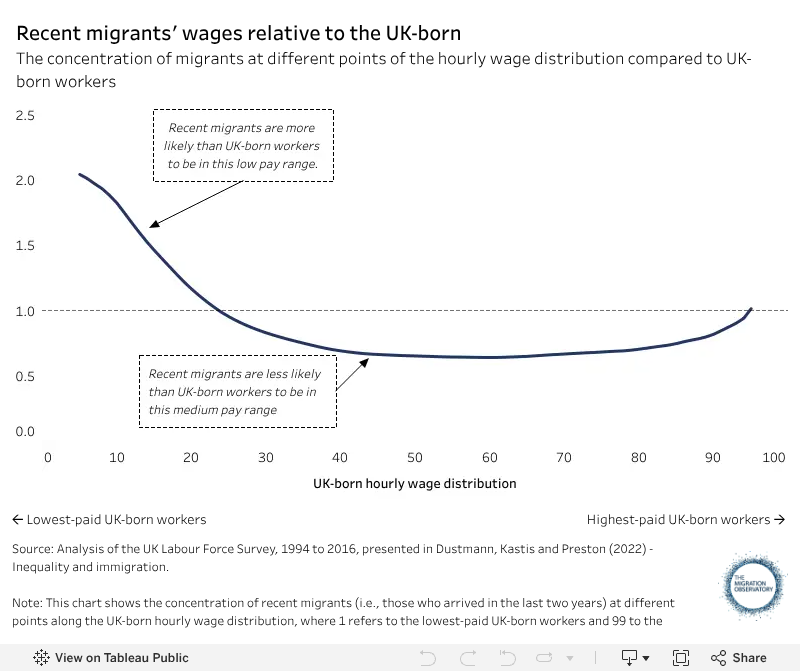
This is presented visually in Figure 1, which shows where recent migrants (i.e., those who arrived in the previous two years) are concentrated in the wage distribution compared to UK-born workers. A value of 2, for example, means that recent migrants are twice as likely as UK-born workers to be in that part of the pay distribution. A value of 1 means they are represented equally, while a value below 1 means they are less likely to be in that pay range. More information on the jobs migrant workers do in the UK can be found in the Migration Observatory briefing, Migrants in the UK Labour Market: An Overview.
Figure 1
Have wage and employment impacts been found in economic research?
A large body of research has examined whether immigration leads to higher unemployment or lower wages among existing workers, and most have found either small or no effects.
In 2018, the Migration Advisory Committee reviewed the results of studies conducted between 2003 and 2018 and drew three conclusions. First, immigration had little or no impact on average employment or unemployment of existing workers. Second, where an impact was found, it was usually concentrated among certain groups – i.e. a negative effect for those with lower education and a positive effect for those with higher levels of education. And third, the impact may depend on the economic cycle; some—though not all—studies have found adverse effects on employment or unemployment, specifically during downturns.
Similarly, the MAC review concluded that immigration had had little impact on average wages, according to previous research. Some studies found a small negative impact on average wages, while others found positive average effects. To our knowledge, there are not yet any similar studies on the impacts of post-Brexit migration.
Are low-paid and high-paid workers affected differently?
Empirical research on the labour market effects of immigration in the UK has found negative effects on low-paid workers and positive effects on high-paid workers, but both effects are small. In other words, immigration is not one of the major factors that shape low-wage workers’ prospects in the labour market.
For example, a 2022 study found that immigration to the UK from 1994 to 2016 reduced the hourly wage of UK-born wage earners at the 5th percentile (i.e. the lowest earners in the labour market) by around half of one pence per year. The gains for top earners were also small: 1.7p per year for people at the 90th percentile of wage earners. Another study focusing on wage effects at the occupational level found that, in low-wage service sector jobs, a 1 percentage point rise in the share of migrants reduced average wages in that occupation by about 0.2%. These results are broadly similar to findings from other studies.
How does immigration impact the wages and employment of other migrants?
Research suggests that any adverse wage effects of immigration are likely to be greatest for resident workers who are themselves migrants. This is because recent and longer-standing migrants are more likely to work in the same occupations, including ones that do not require as many communication skills. As a result, new migrants are likely to be closer ‘substitutes’ for migrants already employed in the UK, and thus in more direct competition.
For example, one study concludes that the main impact of increased immigration from 1975 to 2005 was on the wages of migrants already in the UK. Another, using a different methodology, found that EU migration after the 2004 EU enlargement had a more negative impact on migrants’ employment rates. Their wage results were more mixed—declining for migrants in low-skill jobs but increasing for migrants in medium- and high-skill jobs.
Is there a link between migration and training?
Evidence on how much immigration affects training is limited and has produced mixed results. One study looked at vocational training, such as NVQs and apprenticeships, and found that migration reduced UK workers’ participation in less costly and less economically beneficial types of training. Another found that more immigration was associated with higher training rates of UK-born adults in some sectors and lower in others. In particular, training fell in industries where output was not exported, e.g., construction or hospitality, but increased elsewhere. A third study found that skilled migration might increase workplace training, although the results were inconsistent across different methods.
Employers in some jobs have alternatives to recruiting and training local workers when labour is in short supply. In particular, numerous studies indicate that automation increases when lower migration makes workers scarcer, although automation is not feasible in all occupations.
In other words, it is possible that a decline in migration could push some employers to increase domestic training, but evidence does not provide a clear guide on whether and to what extent this benefit might materialise.
Evidence gaps and limitations
Different types of migration are likely to have different impacts, although research has usually grouped migrants together into large categories, e.g. by their level of education or whether they come from EU or non-EU countries. In reality, there are substantial differences between groups of people who come to the UK on work visas, as family members, as students or as refugees. For more information on different types of migration to the UK, see the Migration Observatory briefing, Who Migrates and Why?
Measuring the labour market effects of immigration is difficult. Migrants often go to areas of the country that are experiencing economic growth and strong labour demand. This makes it difficult to know whether differences between areas with high and low migration result from migration or from other factors. Finally, a lack of data precisely measuring the earnings and locations of migrants and UK-born workers means that existing studies likely have significant measurement error.
Empirical research has employed various methods and econometric techniques to address these issues, but none of them is perfect, and some difficulties and caveats always remain.
Acknowledegements
With thanks to Jonathan Wadsworth and Cinzia Rienzo for their helpful comments on an earlier version of this briefing.


