

This briefing examines immigration detention in the UK. It discusses who is detained, for how long, with what effects, and the financial costs of operating the system.
-
Key Points
- Immigration detention is used worldwide by governments to facilitate immigration enforcement, but has negative impacts on detainees’ mental health.
More… - The use of immigration detention in the UK hit a high of around 32,000 in 2015. Numbers have been falling since then, with around 16,000 people entering detention in 2023.
More… - Around 1,800 people were in immigration detention on 30 June 2024.
More… - In mid-2024, the UK had an estimated detention capacity of around 2,200 beds, of which around 77% were occupied.
More… - In 2023, the Home Office detained 18 children for immigration-related purposes, down from around 1,100 in 2009.
More… - In 2023, 39% of immigration detainees were held for more than 28 days.
More… - Release on immigration bail – an alternative to detention where detainees are released into the community – increased from 2010 to 2021 but fell by 2023.
More… - In Q2 2024, the average daily cost to hold an individual in immigration detention was £122.
More… - In the financial year 2023-24, the Home Office issued 838 compensation payments for unlawful detention, totalling around £12 million.
More…
- Immigration detention is used worldwide by governments to facilitate immigration enforcement, but has negative impacts on detainees’ mental health.
-
Understanding the Policy
In the UK, immigration detention refers to the Home Office practice of detaining foreign nationals for the purposes of resolving their immigration statuses. Most countries use immigration detention. When people are detained, they are typically held in prison-like conditions. ... Click to read more.However, immigration detention is an administrative process rather than a criminal justice procedure. This means that the decision to detain is typically made by Home Office civil servants rather than courts.
Policy reasons for detaining an individual typically include one or more of the following: to conduct initial immigration processing; to remove the person from the UK; to establish their identity or the basis of their immigration or asylum claim; where there is reason to believe they will abscond if released on bail; or when release is not considered to be ‘conducive to the public good’. In some instances, the reasons for a person’s detention change while they are being held. Detention typically ends in either removal from the UK or release, usually on immigration bail.
The Home Office has the administrative power to detain a non-citizen at any point in their immigration process. There are several categories under which people can be detained under Immigration Act powers. Some individuals fall into more than one category. These categories include:
- new arrivals awaiting examination by an immigration officer to determine their right to enter the UK; new arrivals who have been refused permission to enter the UK and are awaiting removal;
- people presenting to an immigration office within the country;
- during a check-in with immigration officials;
- once a decision to remove has been issued;
- following arrest by a police officer;
- after completing a prison sentence;
- those who have either failed to leave the UK on expiry of their visas (‘visa overstayers’), or who have not complied with the terms of their visas, or have attained their visas by deception;
- people in the UK who are awaiting a decision on whether they are to be removed or who are awaiting their removal, such as refused asylum seekers.
Legally speaking, detention must be used as a last resort. Home Office policy and international law state, “Detention must be used sparingly, and for the shortest period necessary” [i]. People can apply for immigration bail and also receive an automatic bail hearing after four months of detention, presided over by an independent First-tier Tribunal judge. Home Office senior officials must now authorise detention continuance after a bail hearing. Unlike other European countries, the UK does not have upper time limits for a person’s immigration detention.
The Home Office detains the vast majority of people in Immigration Removal Centres (IRCs). Other immigration detention spaces include Residential Short-Term Holding Facilities (RSTHFs), a pre-departure accommodation facility (PDA), short-term holding rooms based at ports of entry and at the border, and prisons, usually where a person has completed a prison sentence.
The Home Office also holds people in conditions that are like detention but which are not classified as immigration detention and so are not covered in the government’s immigration detention statistics. For example, the Home Office holds people arriving via small boat at Manston immigration processing centre, a former military base in Kent, to conduct initial processing. The Home Office does not publish statistical records of who it detains in short-term holding rooms or in detention-like sites such as Manston.
Where people are detained
As of 30 June 2024, the UK detention system comprised the following facilities:
Type of facility Facility name Location Occupants Beds Operator Immigration Removal Centres (IRCs) 1. Brook House IRC Gatwick Airport Male only 450 - Serco 2. Colnbrook IRC Heathrow Airport Mixed 330 - Mitie 3. Derwentside IRC County Durham Female only 84 - Serco 4. Dungavel IRC South Lanarkshire, Scotland Mixed 121 Mitie 5. Harmondsworth IRC Heathrow Airport Male only 635 Mitie 6. Tinsley House IRC Gatwick Airport Male only 162 Serco 7. Yarl’s Wood IRC Bedfordshire Mixed 410 Serco Total: 2,192 Residential Short-Term Holding Facilities
(to hold people for up to a week; known as STHFs in Home Office datasets)1. Colnbrook STHF Heathrow Airport Male only - Home Office 2. Larne House STHF County Antrim, Northern Ireland Mixed - 3. Manchester STHF Manchester Airport Mixed - 4. Swinderby STHF Lincolnshire Male only - Pre-departure accommodation (PDA) 1. Gatwick PDA Gatwick Airport within Tinsley House Families with or without children - Home Office Residential holding room Manston in Kent is classed by the government as the only facility falling into this category. These are not counted in the official immigration detention statistics. Short-term holding rooms These are also known as non-residential short-term holding facilities. They are run by Border Force in fifteen ports and airports [i], and at reporting centres across the country, where people may be detained for up to 24 hours. Prisons The UK detains people for immigration purposes in various HM Prisons, usually after people have served a custodial sentence, prior to their removal from the UK. Notes: [i] For a list of ports and airports, see Appendix II in HM Chief Inspector of Prisons (2023), Report on an unannounced inspection of short-term holding facilities managed by Border Force.
As part of the ‘juxtaposed controls’ system established by the Sangatte and Le Touquet treaties, the UK Border Force subcontracts operational responsibility for five STHFs in Northern France. One STHF is in the port of Calais; two are in Coquelles near the Eurotunnel [ii]; and one is located within the port of Dunkerque (Dunkirk).
There are 13 reporting centres in the UK, where some detainees are first detained and where many must subsequently report routinely as a bail condition for their release. Reporting as a condition of immigration bail was temporarily suspended in 2020 due to the COVID-19 pandemic but has since resumed.
The Home Office has outsourced the management of its IRCs to private firms. From late September 2021, two companies – Mitie Care & Custody and Serco – have been managing all of the UK’s IRCs. Mitie runs the Heathrow IRCs (Colnbrook and Harmondsworth), and took over Dungavel from GEO in 2021. Serco manages the remaining four IRCs: Brook House, Derwentside, Tinsley House, and Yarl’s Wood. Immigration detention sites are subject to inspections by His Majesty’s Inspector of Prisons (HMIP). HMIP inspection reports are publicly available.
The Home Office closed several IRCs over the last decade as part of a planned reduction of the UK’s detention system, although two IRCs are now planned to reopen in 2024–25. IRCs Dover and Haslar were closed in 2015, although there are plans for Haslar to be reopened in 2024. The Verne closed in December 2017 and returned to its previous purpose as a men’s prison. Campsfield House closed in December 2018, but there are plans to reopen it in 2025. Morton Hall returned to prison use in 2021 but with an RSTHF on site for men and women.
Between 2011 and 2016, the Cedars Pre-Departure Accommodation operated in West Sussex, where the charity Barnardo’s oversaw welfare services delivered to families detained for short periods before removal. In May 2017, a “discrete self-contained unit” at Tinsley House IRC opened to accommodate families. Families may be held there for up to 72 hours, with a ministerial declaration for “exceptional” cases extending a family’s stay to no more than seven days.
Women in immigration detention
Women are detained either in mixed or single-sex facilities. A new IRC, Derwentside, opened in County Durham on 23 November 2021. Previously known as Medomsley or the Hassockfield Secure Training Centre for young offenders, Derwentside is the only IRC solely for women [iii]. Small numbers of women can also be detained at Colnbrook (called Colnbrook STHF in Home Office statistics) and Dungavel, in residential STHFs like Manchester and Larne House, and in the Kent Intake Unit at Dover.
Home Office policy states that pregnant women may be detained only if removal is imminent or there are exceptional circumstances to justify detention. In 2016, a 72-hour time limit on the detention of pregnant women was enacted, although a government minister can extend this to a maximum of seven days.
Vulnerable adults in detention
The Home Office commissioned a 2016 independent investigation by Stephen Shaw into the welfare of vulnerable people in UK immigration detention. The investigation identified problems in the way the Home Office treated victims of torture or those suffering from mental illness. In response, the Home Office introduced a new Adults at Risk policy. A follow-up report published in 2018 argued that “many people” in IRCs should not have been there.
Asylum processing and accommodation facilities
In recent years, many asylum seekers with pending claims have been housed in a variety of temporary or “contingency” accommodation due to difficulties in sourcing sufficient housing. These have included facilities such as Napier Barracks in Folkestone (which held around 400 asylum seekers at its peak in January 2021 [iv]), Wethersfield, a former RAF barracks in Essex, and the Bibby Stockholm, a barge moored in Portland, South Dorset.
These are not closed sites. However, a High Court judge described the conditions at Napier Barracks in 2021 as “detention-like”, noting the “perimeter fence topped with barbed wire, access to which is through padlocked gates guarded by uniformed security personnel” (p. 39). NGOs and asylum seekers have also criticised large asylum sites for creating detention-like conditions due to restrictions on movement, security surveillance or remote locations (e.g. in the case of Wethersfield).
Since February 2022, the Home Office has been holding people arriving in the UK on small boats at Manston for initial identity and security checks. This former military base in Kent is described by the government as a “secure site” that holds people for short periods. According to the Short-term Holding Facility Rules 2018, which were amended in January 2023, people can be detained at Manston for up to 96 hours, although the Home Office notes that people have been detained at Manston for longer.
References
[i] UK Visas and Immigration (2023). Detention: general instructions. London, UK: Home Office.
[ii] https://detentionforum.org.uk/wp-content/uploads/2022/05/STHF-policy-paper-April-22.pdf
[iii] Legal Aid Agency (2021). Procurement of Detained Duty Advice Scheme Services at Derwentside Immigration Removal Centre from 1 January 2022 Invitation To Tender Information for Applicants.
-
Understanding the Evidence
The publicly available data on immigration detention are found primarily in publications of the Home Office and His Majesty’s Inspectorate of Prisons (HMIP). Home Office detention statistics record people detained under Immigration Act powers in IRCs, STHFs, the PDA and prisons (but not foreign nationals serving criminal sentences in prisons). ... Click to read more.Data on people entering immigration detention are counts of the number of occurrences of people entering detention rather than the number of unique individuals. An individual who enters detention, say, twice in a given period, would be counted twice in the data. Nevertheless, in this briefing we use the term “people entering detention” for simplicity.
The immigration detention statistics exclude people detained for less than 24 hours in short-term holding rooms at seaports, airports and in police cells. Data on people detained in prisons are included from Q3 2017 onwards, but do not include people detained in police cells and short-term holding rooms at ports and airports (for less than 24 hours), nor those detained under both criminal and immigration powers and their dependants. Counts from Q3 2017 onwards are therefore not comparable with those for earlier periods. The detention statistics also exclude people held at Manston.
Data on those in detention relate to the last day of the quarter, e.g. Q1 = 31 March.
Immigration detention is used worldwide by governments to facilitate immigration enforcement, but has negative impacts on detainees’ mental health
All EU and high-income English-speaking countries use immigration detention in the enforcement of immigration laws, although some countries detain more of the people they remove than other countries, and unlike the UK most have an upper limit for how long people can be detained. Home Office guidance states that detention is required for “maintaining effective immigration control, particularly as a means to facilitate the removal of people who have no right to be in the UK but refuse to leave voluntarily”.
Immigration detention is intended to facilitate immigration administration, rather than to punish individuals. However, detention is similar to being in prison, and the negative impacts of being detained are well-established in research. For example, a 2018 systematic review of the effects of immigration detention on mental health examined the findings from 26 studies in several countries across the world. It found that detainees experienced high levels of mental health problems such as anxiety, depression, and post-traumatic stress disorder. The negative impacts were larger when detention lasted longer, and when people had previous exposure to trauma. Research has also found that uncertainty about how long a person will remain in detention is a source of anxiety [1] [2] [3] [4].
The negative impacts of being detained may be exacerbated by the way detention is implemented. Common criticisms include a lack of a maximum time limit, access to adequate physical and mental healthcare [5] [6] [7] and difficulties accessing legal advice [8]. Official investigations have found that conditions at detention centres can vary widely. For example, a 2023 inspection of Tinsley House IRC found that it was “safe and respectful”, while inspections of Harmondsworth (2024) and Yarl’s Wood (2015 and 2023) criticised poor care, safety and cleanliness.
The use of immigration detention in the UK hit a high of around 32,000 in 2015. Numbers have been falling since then, with around 18,400 people entering detention in 2023
Since 2015, there has been a steady decrease in the use of immigration detention. In 2023, around 18,400 people entered immigration detention in the UK, around half as many than in 2015.
The Home Office has said that this decline is due to the government’s response to the 2016 Shaw review of detention, which argued for the use of community-based alternatives to detention. Immigration detention numbers were particularly low in 2020 as a result of the COVID-19 pandemic and the temporary suspension of normal immigration enforcement operations.
Figure 1
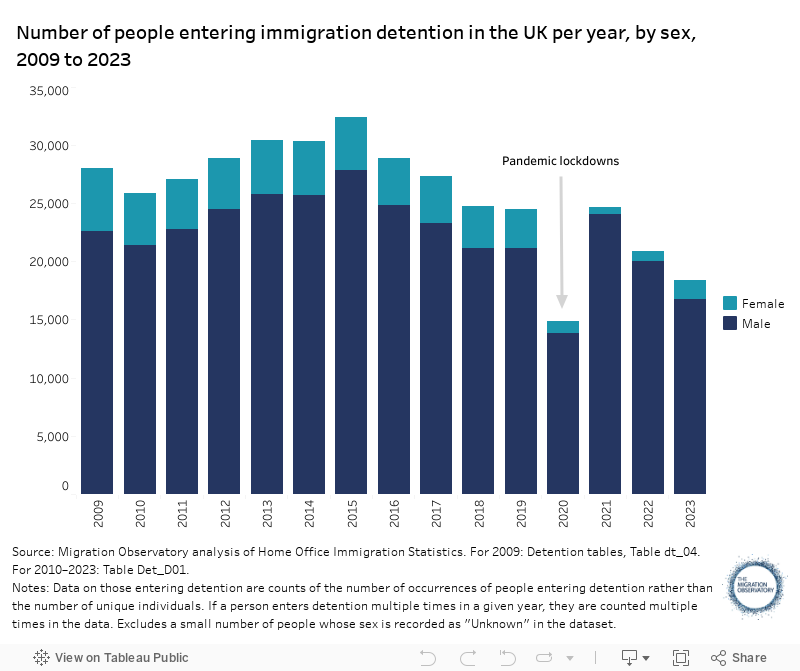
The brief post-pandemic increase in the use of immigration detention in 2021 and 2022 was driven by the detention of people reaching the UK by small boat. These people were typically detained for short periods in order to confirm their identity and register any asylum claim. According to the Home Office, “immigration detention facilities are now rarely used to process small boat arrivals, who are now processed on arrival at the Manston facility”. Manston is a form of immigration detention, but is not counted in the Home Office’s immigration detention statistics.
In any given year, a large majority of those entering detention are male – between 81% and 98% in the 15 years from 2009 to 2023.
Around 1,800 people were in immigration detention on 30 June 2024
The number of people in detention at any one time depends both on the numbers entering detention, and on how long they are detained. On 30 June 2024, there were around 1,800 people detained under Immigration Act powers, including 94 people detained in prisons. This is comparable to pre-pandemic levels at the end of 2019 (Figure 2), despite the fact that the overall number entering detention across the year has fallen. This is because people are being detained for longer, on average (see Figure 6).
Figure 2
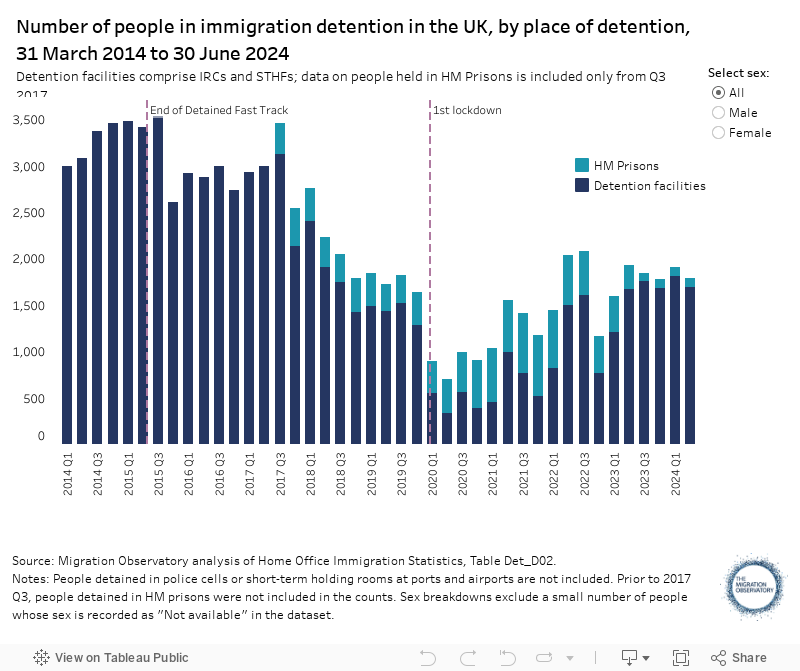
On 30 June 2024, fewer immigration detainees were held in prisons than at almost any other period since 30 September 2017, when statistics were first published on the number of people detained in UK prisons. The prison inspector suggests these low numbers are due to high pressure on prisons.
Home Office analysis has suggested that falls in the total detained population since 2018 might have resulted from (1) the 2018 introduction of automatic bail hearings for most detainees four months after entering detention; (2) the Shaw reviews [9] [10] into immigration detention, after which the government committed to using community-based alternatives to detention; and (3) changes to the immigration system spurred by the “Windrush scandal” that included colleagues checking caseworkers’ decisions, and increasing face-to-face contact time between caseworkers and detainees [11].
In mid-2024, the UK had an estimated detention capacity of around 2,200 beds, of which around 77% were occupied
In December 2022, the government stated that the UK’s seven IRCs could house around 2,200 people. At the end of June 2024, around 1,700 of this capacity was being used (this excludes 94 people held in prisons). Because the capacity has not changed substantially since the government’s 2022 statement (i.e., no IRCs were opened or closed during 2023), this leaves an estimated 530 spaces free (Figure 3).
The Illegal Migration Act (IMA) expanded the government’s powers to detain people, giving the Home Secretary the power to determine what period of detention is reasonable, and restricting judicial challenge of detention.
Figure 3
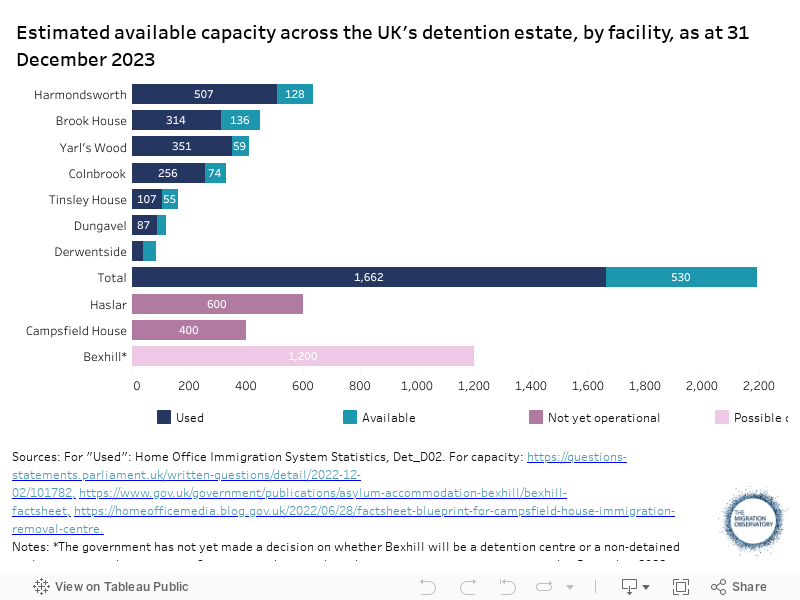
In August 2023, the Home Office published a procurement notice for the creation of ‘new’ immigration removal centres, to provide an additional 1,000 detention spaces. It later announced that two old IRCs that were closed down would be reopened and expanded: Campsfield in Oxfordshire, Haslar in Hampshire. As of November 2024, Haslar and Campsfield had not yet reopened, and the government had not yet decided whether the Bexhill site in Sussex would be an IRC or non-detained asylum accommodation centre.
In 2023, the Home Office detained 47 children for immigration-related purposes, down from around 1,100 in 2009
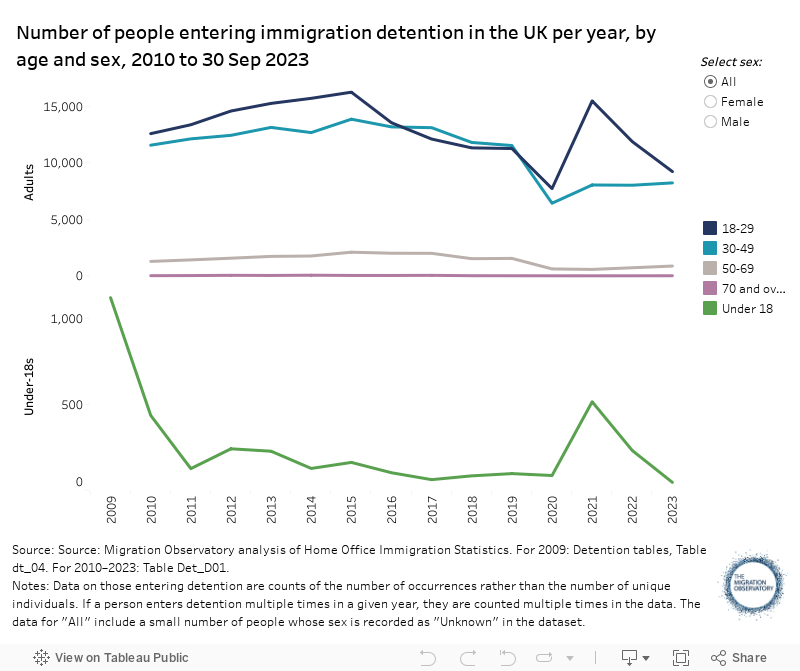
In recent years, few people under 18 or people who are 50 or older, have entered detention. In 2023, 95% of people entering immigration detention were between 18 and 49 years old (see Figure 4).
In the 1990s, the Home Office rarely detained families that included children. Detention of children increased after 2000. Between 2005 and 2009, non-governmental organisations and other groups estimated that up to 2,000 children (i.e., under-18s) per year were detained with their families, primarily in Yarl’s Wood IRC [12] [13].
Home Office statistics record that in 2009, a total of 1,119 children entered detention. In 2010, a policy change under the Conservative and Liberal Democrat coalition government ended the detention of children in IRCs, leading to a substantial fall in the number of children detained. However, a small number of families with children were still detained for short periods at a new specialist centre, the Cedars Pre-Departure Accommodation, which ran between 2011–16 with oversight from children’s charity Barnardo’s. Since Cedars shut, families with children are detained (in low numbers) at Gatwick Pre-Departure Accommodation within Tinsley House IRC. In 2023, 47 children entered immigration detention, the lowest annual number on record (Figure 4). Families can also be held at Manston, though these are not recorded in the immigration statistics.
Figure 4
Detention of EU and non-EU nationals
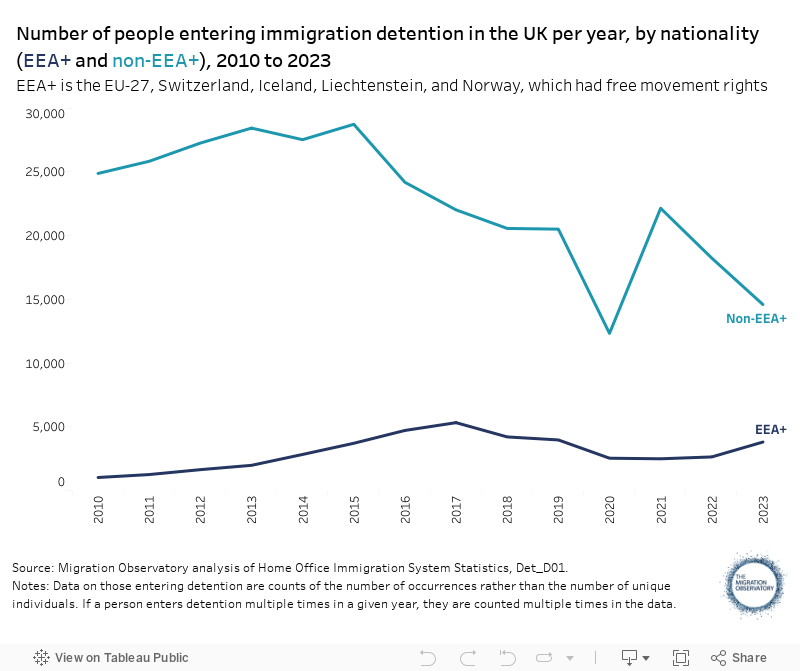
The number of EEA+ (the EU-27, Switzerland, Iceland, Liechtenstein and Norway) nationals in UK immigration detention has always been much smaller than the number of non-EEA+ foreign nationals. However, the number of EEA+ citizens entering immigration detention increased from 1,020 in 2010 (4% of the total), to a peak of 5,324 (19%) in 2017. The numbers fell in subsequent years. In 2023, around 3,800 EEA+ citizens were detained, representing 21% of all those entering detention (Figure 5). The majority of EEA+ citizens detained in the UK are from Eastern Europe, including Romania and Poland.
Figure 5
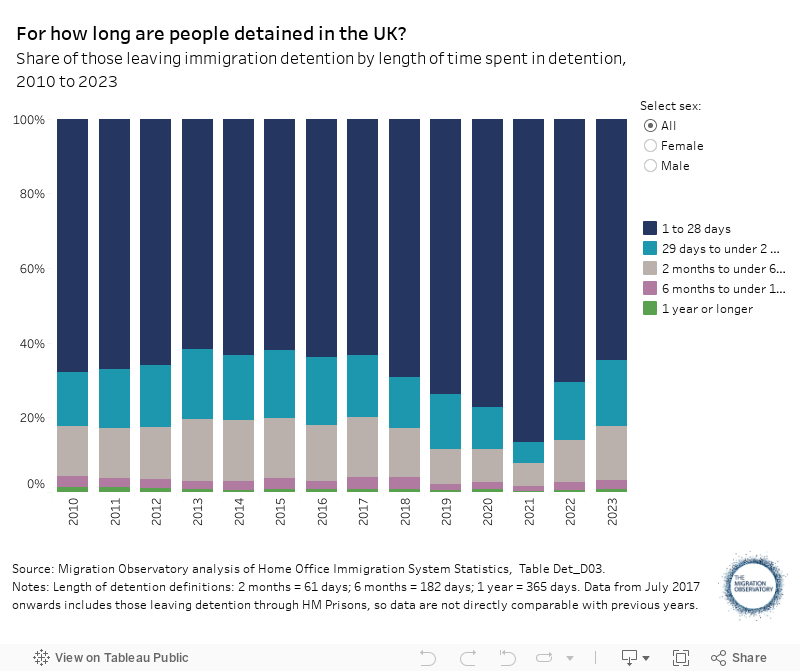
In 2023, 35% of immigration detainees were held for more than 28 days
The UK does not have an upper limit on the time for which a person can be detained. Of people leaving detention in 2023, 65% had been detained for less than 29 days, 18% for 29 days to under 2 months, 14% for 2 months to under 6 months, 2% for 6 months to under 1 year, and 1% had been detained for 1 year or longer (Figure 6).
Female detainees are, on average, held for shorter periods than male detainees (Figure 6; Select sex: Female). The length of detention is also longer for people held in prisons. Just over half (53%) of people who had been held in immigration detention for at least 6 months as of the end of September 2022 (the most recent period available at the time of writing) were former offenders held in prisons, while people detained in prisons made up 22% of all detainees (i.e., those who had been in detention for any period of time as at 30 September 2022). A 2022 inspection report argued that immigration detention in prisons was prolonged by operational failures to progress detainees’ cases and either release or remove them.
Figure 6
Some stakeholders, including HM Chief Inspector of Prisons, the House of Commons Home Affairs Committee, and the All Party Parliamentary Group on Refugees & All Party Parliamentary Group on Migration, have argued that a maximum time limit should be introduced on individual periods of detention, as seen in other European countries. However, to date, ministers have argued that a time limit would make it harder to remove people who have breached immigration laws and will not leave the UK voluntarily, including foreign national offenders.
Release on immigration bail – an alternative to detention where detainees are released into the community – increased from 2010 to 2021, but fell by 2023
Over the last decade, there has been a long-term fall in the share of people leaving immigration detention to be returned to their country of nationality or habitual residence. In 2010, 64% of people leaving detention departed the UK directly, either voluntarily or under Home Office enforcement. In 2023, the figure was 39% (Figure 7). By contrast, the share of those released temporarily from detention on immigration bail trended upwards from 2010, reaching a peak of 86% in 2021, before falling to 55% in 2023. The remainder include people who died in detention, who were released unconditionally, or transferred from immigration detention to criminal detention, or who left detention to be sectioned under the Mental Health Act.
Immigration bail is a less restrictive alternative to detention that grants people greater liberty whilst still giving the government a degree of control over the individual’s movements. People in detention can be released on immigration bail for a variety of reasons and the statistics do not routinely identify the reason.
First, some people are detained not for removal but for initial immigration processing (as in the case of many people arriving via small boat). Between 2017 and 2019, between 20% and 30% of people leaving detention each year had been detained on arrival in the UK. The Home Office has said that the spike in bail releases seen in the statistics in 2021 reflected the Home Office’s strategy at that time of detaining people arriving by small boat in immigration detention for short periods before releasing them on bail, such as after they lodged an asylum claim. While these short detentions still occur, they are typically not included in the statistics, which do not include initial processing at Manston.
Second, people may leave detention on immigration bail because they have claimed asylum after being detained for removal. In 2019, an estimated 47% of people detained ahead of removal following immigration offences claimed asylum and in most cases this led to their release from detention. Asylum was the most common legal issue raised in detention by people facing removal, followed by medico-legal reports challenging the detention on medical grounds such as a history of torture.
Third, people who are detained for removal may be released on immigration bail if the Home Office is not able to remove them in a reasonable timeframe, for example because the detainee’s country of nationality does not accept their return.
Figure 7
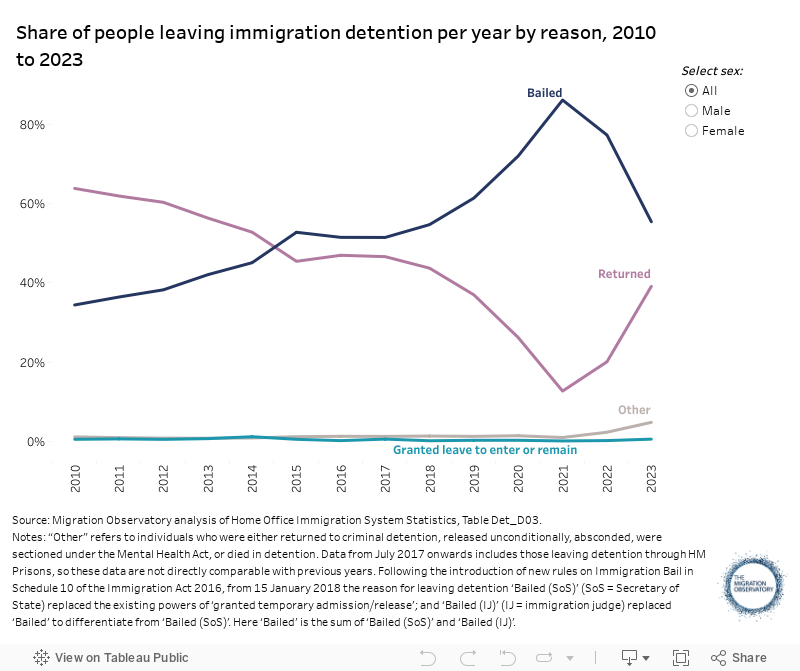
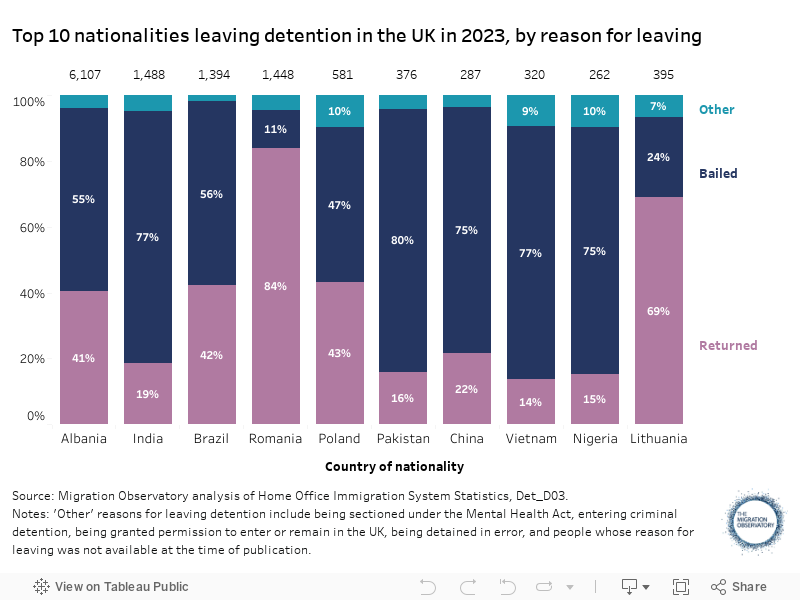
The increase in returns from detention in 2022 and 2023 is mainly explained by the increasing number of Albanians removed following the UK-Albania agreement signed in December 2022. Around 2,500 Albanians left detention in 2023 to be returned (Figure 8).
Figure 8
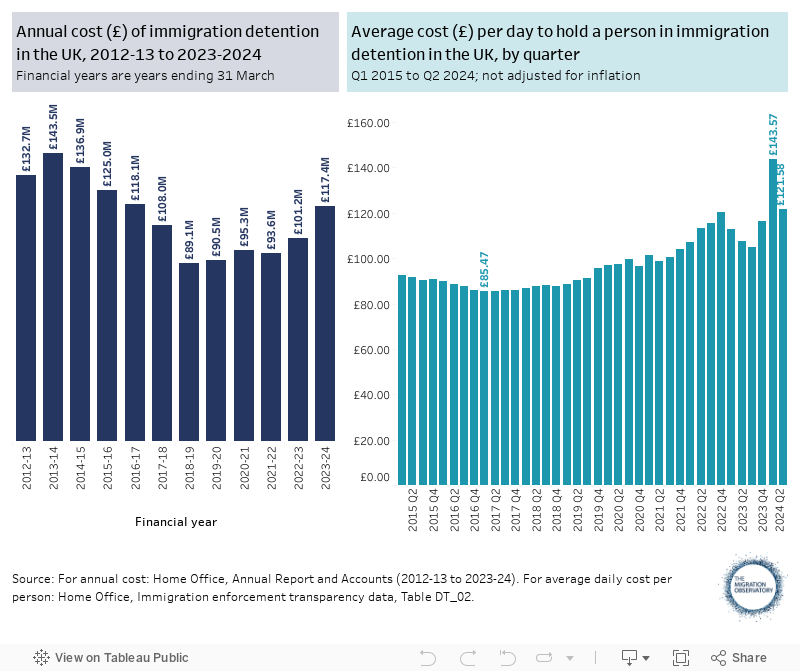
In Q2 2024, the average daily cost to hold an individual in immigration detention was £122
The annual financial cost of operating the UK’s detention system for the year ending 31 March 2024 was around £117 million, down from around £144 million in the year ending March 2014 (Figure 10, left chart). The lower costs result from reductions in the size of the detention estate, and fewer people being held in immigration detention.
The average daily cost of keeping an individual in immigration detention has increased gradually since 2017, reaching £122 in Q2 2024 (Figure 9, right chart).
Figure 9
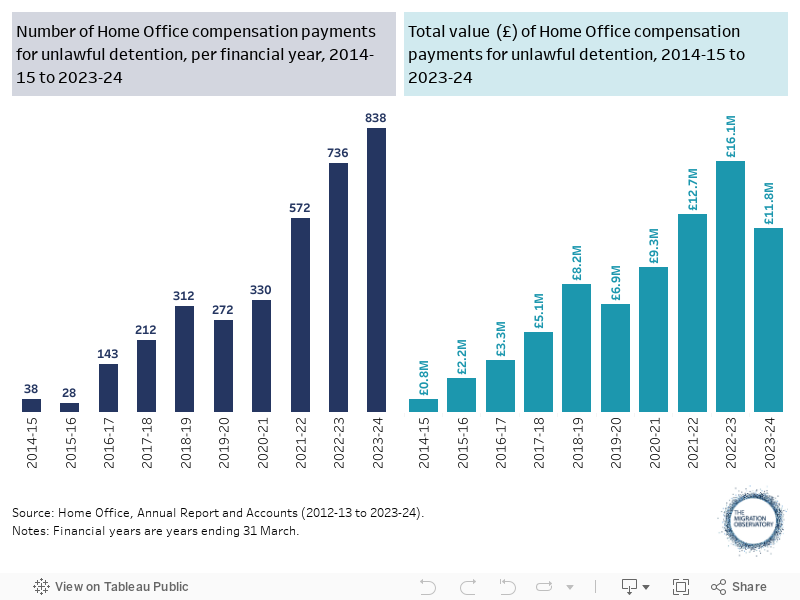
In the financial year 2023-24, the Home Office issued 838 compensation payments for unlawful detention, totalling around £12 million
Courts may order the Home Office to compensate people it has detained unlawfully. In recent years, the Home Office has issued an increasing number of compensation payments for wrongful detention. In the year ending March 2024, there were 838 proven cases of unlawful detention, for which a total of £11.8 million was paid in compensation (an average payment of around £14,000 per case). This was up from £0.8m paid for 38 cases in 2014-15 (Figure 10).
Figure 10
Evidence Gaps and Limitations
There are three notable deficiencies in the available data on immigration detention in the UK. Most recently, there are a lack of data on people held at the Manston immigration processing centre, which is immigration detention, but is not counted in the official statistics on immigration detention. Second, and more generally, it is not possible to track individual trajectories of detention, release, and re-detention through the statistics, because the Home Office presents data for separate numbers of occurrences of entering detention, rather than data for unique individuals. Third, the Home Office does not provide information in the public statistics about how many people are being held on which policy ground for detention.
Acknowledgements
With thanks to Stephanie Silverman for authoring previous versions of this briefing and Gemma Lousley at Women for Refugee Women for helpful comments on drafts of this briefing.
References
[1] Griffiths, M. (2013). Living with uncertainty: Indefinite immigration detention. Journal of Legal Anthropology, 1(3), 263-286.
[2] Turnbull, S. (2016). ‘Stuck in the middle’: Waiting and uncertainty in immigration detention. Time & Society, 25(1), 61-79.
[3] Bosworth, M. (2012). ‘Subjectivity and identity in detention: Punishment and society in a Global Age.’ Theoretical Criminology. 16(2): 123-140.
[4] Bosworth, M. (2014). Inside Immigration Detention. Oxford: Oxford University Press.
[5] Jesuit Refugee Service (2020). Detained and dehumanised: The impact of immigration detention.
[6] Bail for Immigration Detainees (2019). “Nothing good comes from detention”: Voices from detention.
[7] Medical Justice (2023). Clinical safeguards continue to fail across all IRCs.
[8] Jesuit Refugee Service (2020). Detained and dehumanised: The impact of immigration detention.
[9] Shaw, S. (2016). Review into the welfare in detention of vulnerable persons: A report to the Home Office by Stephen Shaw. London, UK: HMSO.
[10] Shaw, S. (2018). Assessment of government progress in implementing the report on the welfare in detention of vulnerable persons: A follow-up report to the Home Office by Stephen Shaw
[11] Joint Select Committee on Human Rights (2019). Windrush generation detention: Government Response to the Committee’s Sixth Report of Session 2017–19. London, UK: House of Commons.
[12] Crawley, H., & Lester, T. (2005). No Place for a child: Children in UK Immigration Detention: Impacts, Alternatives and Safeguards. London: Save the Children England Programme.
[13] Sankey, I., Farthing, S., & Coles, A. (2010). Liberty’s submission to the review into ending the detention of children for immigration purposes. London, UK: Liberty.
-
Media Coverage
-
Independent (26 Oct 2016)
http://www.independent.co.uk/news/uk/politics/compensation-immigration-illegally-detained-home-office-a7381966.html
-
Independent (26 Oct 2016)


